
Free Online Code Compiler — Run HTML, CSS & JavaScript Live in Your Browser
There’s a moment every WordPress developer knows. You have a code snippet — a custom HTML widget, a CSS tweak, a JavaScript function someone shared — and you need to know if it works before you touch the live site.
What do you do?
Some developers paste it straight into the WordPress Customizer and hit publish. If it breaks, they scramble to undo it. Some set up a local environment — XAMPP, Local WP — which takes 20 minutes for a 30-second test. Some try it in browser DevTools, lose the code when they refresh, and start over.
None of those are good answers.
The right answer is a website code runner. Paste your HTML, CSS, and JavaScript. Hit Run. See exactly what the output looks like — on desktop, tablet, or mobile — before any of it goes near a live site.
This tool does exactly that. No login. No install. No account. Free. And it works in any browser.
⚠️ User Personal Experience
Let me share something I have never told anyone before. I am a coding developer, and I have been learning to code for quite a while. I used to practice on my PC, starting with a professional class and then moving on to YouTube tutorials. Once I learned the basics, it was time to put that knowledge into practice and start building websites.
I would write code, but I hit a major wall: my PC was not powerful enough to run VS Studio. It wouldn’t even install properly. I deleted so many files, tried to free up space, but it just wouldn’t work. I was under so much stress, thinking about how frustrating it is to be held back by lack of resources—I couldn’t even do my own work.
I kept searching on Google for a solution until I found a website by the WP Skillz team. They completely won my heart. They have built so many tools, but the one that changed everything for me was their Code Compiler. It allowed me to write code and test how it looked in real-time, all in one place, without needing high-end PC specs. I learned to code and test directly in my browser. It’s truly amazing! Now, I even use it on my mobile phone. I have shared a few more tips about it below.
⚠️ User Personal Tips:
Here is a tip for those using this tool: it has an incredibly useful feature beyond just responsive testing. You can analyze your entire website or specific sections of it right here in one place. Not only can you check for responsiveness, but the website is also packed with other built-in features, including a “Dark Mode” option. You’ll find the tools at the top and the detailed instructions for usage below. Give it a try!
What This Tool Does — and Why WordPress Developers Need It
Most code runners online are built for general programming — Python, Java, C++. They’re overkill for what WordPress developers actually do day-to-day.
What WordPress developers need is different:
- Test a custom HTML block before pasting it into Gutenberg
- Check a CSS snippet before adding it to the WordPress Customizer
- Preview a JavaScript animation or function before putting it in a plugin
- Test a complete HTML email template before sending
- Quickly build a proof-of-concept for a client without setting up a project
This free online code editor is built specifically for HTML, CSS, and JavaScript — the three languages that power every WordPress front-end. You don’t need a server. You don’t need PHP to be running. The browser executes HTML, CSS, and JavaScript natively, and that’s exactly what this tool uses.

It’s a live code editor online that runs entirely in your browser — no server-side code execution, no waiting for compilation, no configuration.

How to Use the Website Code Runner — Step by Step
This tool is fast to learn. Here’s the complete process:
Step 1
Open the HTML Panel and Write Your Structure
Click in the HTML text area. Write your HTML — just the content that would normally go inside the <body> tag. You don’t need to write <!DOCTYPE html>, <html>, <head>, or <body> — the tool wraps those automatically.
Example for a simple button:
<button id="myBtn">Click Me</button>
<p id="output"></p>
Step 2
Add Your CSS in the CSS Panel
Click in the CSS text area. Write your styles exactly as you would in a .css file. No <style> tags needed — the tool adds those automatically.
button {
  background: #0078ff;
  color: white;
  padding: 12px 24px;
  border: none;
  border-radius: 8px;
  cursor: pointer;
}
Step 3
Add JavaScript in the JS Panel
Click in the JavaScript text area. Write your JavaScript — no <script> tags needed.
document.getElementById('myBtn').addEventListener('click', function() {
  document.getElementById('output').textContent = 'Button clicked!';
});
Step 4
Hit Run
Click the Run button. The 5-second timer bar starts filling. When complete, the preview iframe shows your rendered code. You’ll see the button, styled with your CSS, and clicking it will trigger the JavaScript.
Step 5
Check Responsiveness
Click the Tablet button (768px) to see how your layout responds at tablet width. Click Mobile (420px) to see the mobile view. If your CSS has media queries, they’ll fire at the correct breakpoints in the preview.
Step 6
Download or Copy
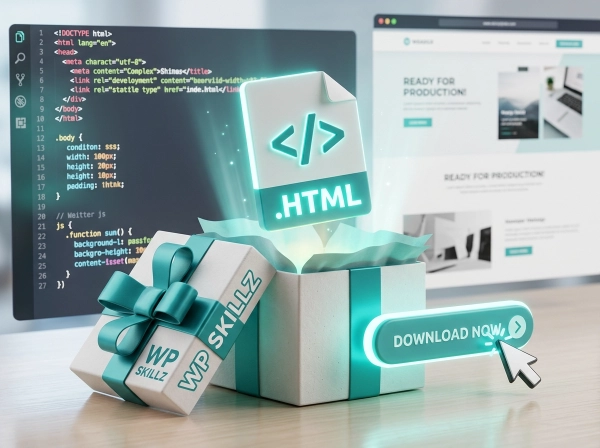
If you’re happy with the result, click Download to save the complete HTML file. Or select the code from the panels and copy it to use in WordPress.
Real Use Cases for WordPress Developers
This isn’t a theoretical tool. Here are the specific situations where I use a website code runner in my actual WordPress development workflow:
Testing WordPress Widget HTML WordPress text widgets and HTML blocks accept raw HTML. Before I paste any custom HTML into a widget, I test it here. I can check exactly how it renders, style it with CSS, and add interactivity with JavaScript — all before touching the live site.
Custom HTML Email Templates Email templates are HTML files. When I’m building a custom HTML email for a WordPress site — a transactional email, a newsletter template — I prototype it here first. The mobile preview mode shows me how it’ll look on a phone.
Debugging CSS Conflicts When a WordPress theme has a CSS conflict with a plugin, I isolate the problematic elements here. I recreate just the affected HTML structure and CSS in the tool and experiment with fixes. Once I know the fix works, I add it to the WordPress Customizer.
Client Proof-of-Concepts A client wants to see a specific interaction — a hover effect, an animated counter, a custom tooltip. I build it in this tool in 10 minutes and share the downloaded HTML file. They can open it in any browser, see it working, and approve or request changes — all without me touching their site.

Testing Shortcode Output WordPress shortcodes often output HTML that you want to style. I paste the shortcode output HTML here, add CSS targeting it, and test the styles. Then I copy the CSS into the theme’s custom CSS area.
Learning HTML and CSS This tool is genuinely excellent for learning. If you’re new to WordPress development and want to understand how HTML and CSS work together, this live code editor online lets you experiment immediately. Change a color value and see what happens. Add a CSS class and apply styles to it. The feedback is instant.
If nothing appears in the preview — make sure you clicked Run after writing your code. The preview doesn’t update automatically — it requires a manual Run trigger.
What Results You Get — Reading the Preview
When the preview loads, you’re seeing a real browser render of your code. What you see is what a visitor to your WordPress site would see if you used this exact code there.
If the layout looks wrong at Desktop width — the problem is in your HTML structure or your base CSS. Check for missing closing tags, wrong display properties, or incorrect CSS values.
If the layout breaks at Tablet width — your media queries may not be firing at the right breakpoints, or you have fixed-width elements that don’t adapt. A common issue: setting width: 600px on a container that needs to be max-width: 600px instead.
If the layout breaks at Mobile width — same as tablet but more extreme. Check for fixed widths, images without max-width: 100%, and text that overflows its container.
If JavaScript doesn’t work — check the code in the JS panel for syntax errors. A missing semicolon, an unclosed bracket, or a typo in a function name will prevent the script from running. Open your browser’s DevTools (F12) for error messages.
Benefits of Using a Browser-Based Code Runner vs Local Setup
A lot of developers default to setting up a local environment for code testing. Here’s why a free online code editor like this is often the better choice for quick tests:
| Factor | Local Setup (XAMPP/Local WP) | This Code Runner |
|---|---|---|
| Setup time | 15–30 minutes first time | Zero — open and use |
| Running requirements | PHP, Apache/Nginx, database | Just a browser |
| Good for quick tests | No — heavy for small tasks | Yes — instant |
| Works anywhere | No — only your machine | Yes — any device |
| Saves automatically | Only if configured | Download button |
| Mobile preview | Requires separate device | Built-in preview |
| Cost | Free but complex | Free and instant |
For testing a single HTML widget, a CSS snippet, or a JavaScript function, spinning up a local environment is like using a bulldozer to plant a flower. This tool is the right size for the job.
The Comparison: Why Our Tool Wins for Quick Prototyping
| Feature | Our Code Runner | CodePen | JSFiddle |
| Login Required | No | Yes (to save/export) | Optional |
| Download .html File | Free & Instant | Pro Feature | Limited |
| Responsive Toggles | Built-in (3 Sizes) | Manual/Pro | Limited |
| Privacy | Private by Default | Public (Free Tier) | Public |
| Ad-Free UI | Yes | No | No |
Common Mistakes When Using an Online Code Runner
Forgetting to click Run after changing code. The preview doesn’t auto-update. Every change requires a new Run click. This is intentional — auto-update can cause performance issues with complex JavaScript.
Writing full HTML document structure in the HTML panel. You don’t need <!DOCTYPE html>, <html>, <head>, or <body> tags. The tool adds those. If you include them, you’ll get nested HTML documents which can cause rendering issues.
Adding <style> tags in the CSS panel. Just write the CSS rules. No <style> wrapper needed.
Adding <script> tags in the JS panel. Just write the JavaScript. No <script> wrapper needed.
Testing server-side code here. This tool runs HTML, CSS, and JavaScript only. PHP, Python, database queries — anything that requires a server — won’t work. For WordPress PHP testing, you need a local or staging environment.
Expecting external resources to always load. If your HTML references an image or script from an external URL, that resource needs to be publicly accessible. Resources from localhost or private servers won’t load in the iframe.
HTML, CSS, and JavaScript — Quick Reference for Beginners
If you’re new to web development and using this tool to learn, here’s the essential context:
HTML — Structure
HTML (HyperText Markup Language) defines what’s on the page. Every element has an opening tag and a closing tag. The content goes between them.
<h1>This is a heading</h1>
<p>This is a paragraph.</p>
<a href="https://wpskillz.com">This is a link</a>
<img src="image.jpg" alt="Description">
HTML doesn’t control how things look — that’s CSS. HTML just says “there’s a heading here, there’s a paragraph there.”
CSS — Style
CSS (Cascading Style Sheets) controls how HTML elements look. You target elements by tag name, class, or ID and apply styles.
h1 {
  color: #0078ff;
  font-size: 32px;
}
p {
  line-height: 1.6;
  color: #333;
}
.my-class {
  background: #f5f5f5;
  padding: 20px;
  border-radius: 8px;
}
The “cascading” part means styles flow down — if a parent element has a color, child elements inherit it unless overridden.
JavaScript — Behavior
JavaScript makes pages interactive. It responds to user actions (clicks, typing, scrolling) and can change the page content dynamically.
// Wait for the DOM to be ready
document.addEventListener('DOMContentLoaded', function() {
  // Find the element
  const btn = document.getElementById('myButton');

  // Add an event listener
  btn.addEventListener('click', function() {
    // Do something when clicked
    alert('Button was clicked!');
  });
});
JavaScript runs in the browser — no server needed. That’s why this html code runner can execute JavaScript client-side without any backend.
| Feature | What It Does |
|---|---|
| HTML Panel | Write your page structure |
| CSS Panel | Write your styles |
| JavaScript Panel | Write your scripts and logic |
| Run Button | Combines code and renders in iframe |
| 5-Second Timer | Progress indicator during code load |
| Desktop Preview | Full-width iframe rendering |
| Tablet Preview | 768px width rendering |
| Mobile Preview | 420px width rendering |
| Download Button | Exports complete .html file |
| Dark Mode | Switches interface to dark theme |
| 8 Color Themes | Changes accent color of the tool |
| Sandbox Mode | Safe JavaScript execution |
Live HTML Editor: Why Developers Choose Us Over CodePen or JSFiddle
While platforms like CodePen and JSFiddle are great for social coding, they often add unnecessary friction for a WordPress developer who just wants a quick test. Here is why our Instant Code Runner is a game-changer:
Zero Account Friction: No “Sign Up to Save,” no email verification, and no passwords. You arrive, you code, you leave.
Privacy-First Testing: Unlike public playgrounds, your code isn’t saved to a searchable public profile. It lives only in your browser session.
Clean “Pro” Features for Free: Most competitors gate “Export to HTML” or “Responsive Views” behind a $12+/month subscription. We provide Instant HTML Downloads and Mobile/Tablet toggles 100% free.
No Dependency Bloat: We don’t force-load heavy libraries. Your code runs in a clean environment, making it easier to spot real errors.
How the Code Compiler Works — The Technology Behind It
Understanding the technology makes you use the tool better. Here’s exactly what happens when you write code and hit Run:
Three Separate Input Panels
The tool has three text areas: HTML, CSS, and JavaScript. Each one is independent. You write your HTML structure in the first box, your styles in the second, and your scripts in the third.
This separation is deliberate. In real web development, HTML, CSS, and JavaScript live in separate files — index.html, styles.css, script.js. This tool mirrors that structure. It keeps your code organized and makes it easier to isolate problems. If something looks wrong, you immediately know whether it’s a structural issue (HTML), a styling issue (CSS), or a behavioral issue (JavaScript).
The Run Process — Blob URL Method
When you click Run, the tool combines your three code sections into a complete HTML document:
[your HTML content]
<style>[your CSS content]</style>
<script>[your JavaScript content]</script>
This combined string is converted into a Blob — a binary representation of the HTML file — using the browser’s native Blob API. A temporary URL is created for that Blob using URL.createObjectURL(). That URL is loaded into the iframe as the source.
The result: the iframe renders a complete, real HTML page generated from your code. It’s not a simulation. It’s not an approximation. The browser renders your code exactly the way it would render a real .html file — because technically, it is one.
After 15 seconds, the Blob URL is automatically revoked using URL.revokeObjectURL() to free memory. This is why running the same code twice works fine — each run creates a fresh Blob.
The 5-Second Timer Bar
The blue progress bar that fills across the top of the preview area is a 5-second countdown using CSS transition: width linear. The code compiles and the preview loads at the end of that timer. This intentional delay gives the browser time to process complex JavaScript without causing a frozen interface, and it gives you a visual cue that something is happening.
For simple HTML and CSS, the preview will be ready before the bar even finishes. For JavaScript-heavy code with animations or API calls, the full 5 seconds gives scripts time to initialize.
Sandbox Mode — Safe Code Execution
The iframe uses sandbox="allow-scripts". This is a security attribute that restricts what the iframe can do. It allows JavaScript to run inside the iframe but blocks it from:
- Accessing the parent page’s DOM
- Making form submissions
- Opening new windows or popups
- Accessing cookies or localStorage from the parent page
This means your code runs safely — whatever JavaScript you paste in cannot affect the WP Skillz page around it or access your browser’s stored data. You can run any client-side code without worrying about unintended side effects.
Preview Size Controls — Desktop, Tablet, Mobile
Three buttons below the Run button control the preview width:
- Desktop (100%) — full width preview, simulating a standard monitor
- Tablet (768px) — sets iframe width to 768px, the standard breakpoint for tablet layouts
- Mobile (420px) — sets iframe width to 420px, simulating a modern smartphone screen
Switching between these doesn’t re-run your code — it just changes the iframe’s CSS width. This lets you see immediately whether your layout is responsive. If your CSS uses media queries that fire at 768px, switching to Tablet mode will trigger those queries in the preview.
This is the css code runner functionality — not just executing code, but letting you test it at real device widths without leaving the tool.
Download Button — Real HTML File Output
The Download button creates a complete my-code.html file using your combined HTML, CSS, and JavaScript. Click it and the file downloads immediately to your computer. Open it in any browser and it works exactly like the preview.
This is useful when you’ve built something in the tool and want to send it to a client for review, save it as a template, or transfer it to your WordPress site.
Dark Mode and Color Themes
The dark mode toggle switches the tool’s interface between light and dark backgrounds. Eight color themes change the accent color throughout the interface: Blue, Red, Green, Purple, Teal, Orange, Pink, Gold.
These don’t affect code execution — they’re purely for comfort during longer coding sessions. Dark mode is particularly useful at night or in low-light environments where a bright white editor causes eye strain.
Here’s a full summary of what the tool provides:
Code Runner Checklist — Before You Use Code on a Live WordPress Site
After testing in the code runner, go through this before copying code to your WordPress site:
- Code renders correctly in the Desktop preview
- Layout is responsive — checked in Tablet (768px) and Mobile (420px)
- JavaScript functions work as expected — button clicks, animations, logic
- No obvious CSS conflicts — tested in isolation here, but note that WordPress loads additional stylesheets
- Downloaded the .html file as a backup before making changes on the live site
- Code doesn't contain any external resource URLs that might be broken or slow
- Images referenced in the HTML have alt text
- JavaScript doesn't use deprecated browser APIs that might not work in older browsers
Test Before You Touch the Live Site
Every experienced WordPress developer has a story about code that broke something on a live site. A CSS rule that collapsed the header. A JavaScript snippet that threw an error and broke the contact form. A widget HTML that rendered completely differently than expected.
The fix isn’t to be more careful. The fix is to test first — every time — in a safe environment where mistakes don’t matter.
This website code runner is that environment. It’s free, it’s instant, and it’s built specifically for the HTML, CSS, and JavaScript that WordPress developers work with every day.
Write your code. Hit Run. Check all three preview sizes. Download the file. Then — and only then — put it on your site.
The tool is above. Your next code test is 30 seconds away.
WP Skillz — WordPress tutorials, tools, and honest developer experience. Built by a developer who learned the hard way to test before deploying. 🔗 Linkedin
Frequently Asked Questions (FAQs)
What is a website code runner and why do WordPress developers need one?
A website code runner is a browser-based tool that lets you write HTML, CSS, and JavaScript and immediately see the rendered output. WordPress developers use it to test custom code — widgets, CSS tweaks, JavaScript functions — before adding them to a live site. It’s faster than setting up a local environment and safer than testing directly on production.
Can I test WordPress shortcode output in this tool?
Yes. Copy the HTML that a WordPress shortcode generates — you can see this by using your browser’s Inspect Element on the frontend — and paste it into the HTML panel. Then add CSS targeting those elements in the CSS panel. Test your styles here and copy them to the WordPress Customizer when you’re satisfied.
What is the difference between this and CodePen or JSFiddle?
CodePen and JSFiddle are excellent tools but require accounts to save work and have more complex interfaces. This tool is zero-friction — open it, paste your code, hit Run, done. It’s designed specifically for quick tests without any signup or project management overhead. The download button and responsive preview modes are also features that CodePen’s free tier limits.
Why does the preview take 5 seconds to load?
The 5-second timer is intentional. It gives JavaScript-heavy code time to initialize and prevents the interface from freezing during rendering. For simple HTML and CSS, the preview will be ready well before the timer finishes. For complex animations or scripts that load external libraries, the 5 seconds ensures everything is ready before displa
Can I run PHP or Python code here?
No. This tool runs HTML, CSS, and JavaScript — all client-side languages that the browser executes natively. PHP, Python, Node.js, and other server-side languages require a server to execute. For those, you need a local environment like XAMPP or a staging server.
Is my code saved anywhere?
No. The code exists only in your browser’s memory during your session. When you close the tab or refresh, the code is gone. If you want to keep your code, use the Download button to save the complete HTML file before closing. This is intentional — no data is stored on any server.
Why should I use this over an offline IDE like VS Code?
VS Code is for building projects; this Live HTML Editor is for testing snippets. If you just need to see if a CSS button hover-effect works, opening an IDE is overkill. Our tool gives you a rendered result in under 5 seconds with zero setup.
What the WP Skillz Community Says
Average Rating: 4.9/5 based on our beta users